Backlinks and the 5 pillars of SEO: where indexing fits
Backlinks are not a separate chapter of SEO. They connect to the five pillars that hold your entire rankings together. If one fails, the whole system suffers.
 AdriánSep 2, 202610 min read
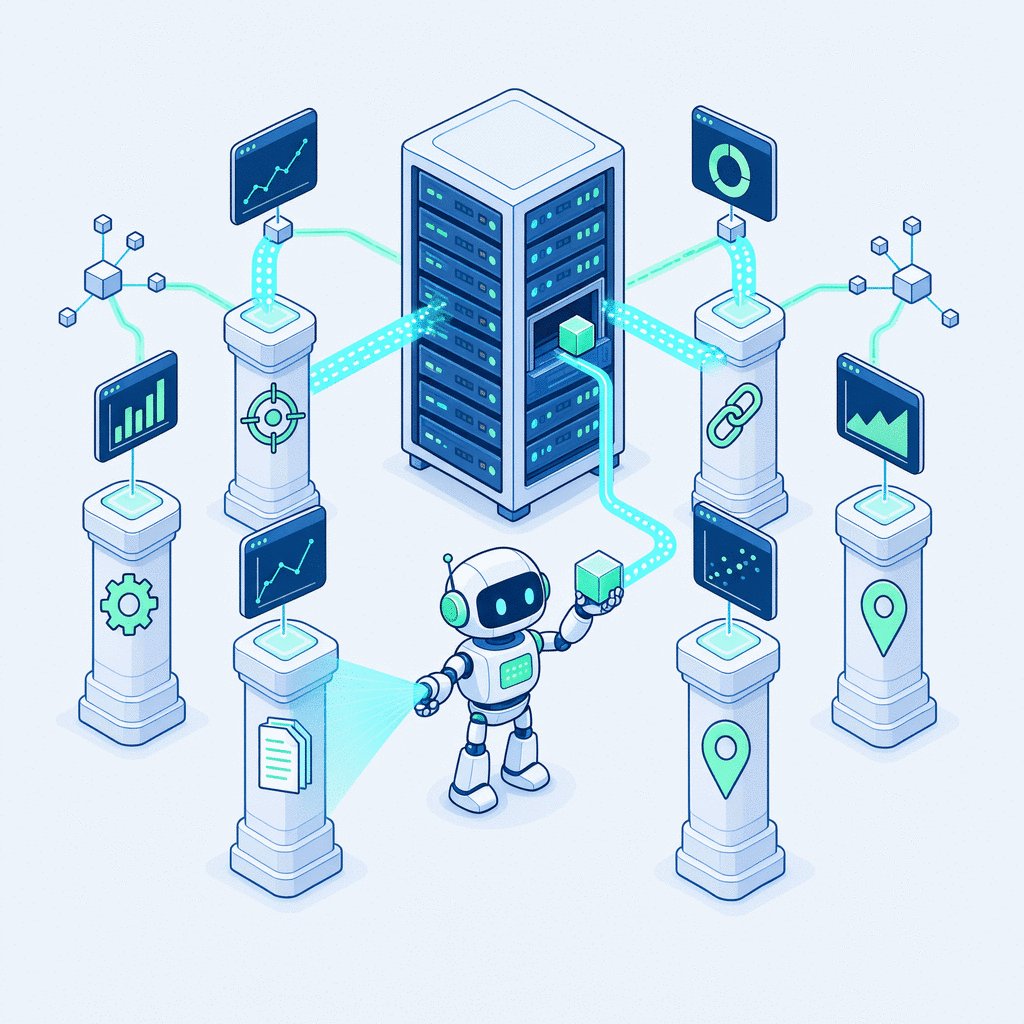
Backlinks are not an isolated topic
In SEO it is easy to fall into the trap of thinking in compartments. Technical on one side, content on another, links in a separate drawer. But rankings do not work that way. Google evaluates your site as a system, not as a sum of independent parts.
Backlinks connect to every one of the pillars that hold your SEO together. If you have good links but your site loads slowly, the impact gets diluted. If you have excellent content but nobody links to you, Google has no way of knowing your content is good. Everything connects.
This article is not an exhaustive SEO guide. It is a map for understanding how backlinks interact with each pillar, and why indexing is the point that ties them all together.
Pillar 1: technical SEO
Technical SEO covers what happens under the hood: load speed, responsive design, URL structure, XML sitemap, robots.txt, structured data, SSL certificate. These are the foundations that allow Google to crawl and index your site without problems.
How do backlinks connect to this? In two ways.
First: when an authoritative site links to you, Google's crawlers follow that link to discover and crawl your pages. A good backlink profile speeds up crawling. If you just published a new page and a high-traffic site links to you, Google discovers it faster than if you had to wait for it to pick up your sitemap.
Second: if your site has technical problems, backlinks lose effectiveness. A link points to a page that loads in 8 seconds, Google crawls it, sees the experience is poor, and the value of that link decreases. The authority the link transmits hits a technical wall.
The minimum you need before investing in link building: loads in under 3 seconds, HTTPS active, sitemap updated, no crawl errors in Search Console. If this is not resolved, you are building on sand.
Pillar 2: on-page SEO
On-page SEO is what you control within your pages: titles, headings, meta descriptions, body text, internal links, images with alt text, keyword density (without going overboard).
Backlinks do not replace on-page. They amplify it.
When someone links to you with anchor text that matches your target keyword, they are telling Google: "this page is about that." That reinforces the signal your own content already sends. It is like a professor recommending a book to another professor and saying "this book is about labor law." The recommendation and the book's content say the same thing, and that doubles the signal.
But if your on-page is weak, backlinks cannot compensate. If your title does not reflect the content, if your headings have no logical structure, if there are no internal links connecting your pages, the external link arrives at a site Google does not understand well. The value gets lost.
A detail few mention: internal links distribute the authority you receive from external backlinks. If one of your pages accumulates several quality backlinks, internal links from that page to other pages on your site channel that authority. Without internal links, the authority stays concentrated in a single page and does not benefit the rest.
Pillar 3: off-page SEO
This is where backlinks live directly. Off-page SEO includes everything that happens outside your site and affects your rankings: inbound links, brand mentions, social signals, reviews, presence in relevant directories.
Backlinks are the most heavily weighted off-page factor. We have covered this in detail in other articles: guest posting, broken link building, unlinked mentions, Digital PR, content magnets. All are techniques for building your inbound link profile.
But off-page is not just link quantity. Google evaluates the quality of your overall profile:
- Do the links come from sites relevant to your industry?
- Do the anchor texts have a natural distribution (branded, generic, partial match, exact match)?
- Were the links acquired gradually or in suspicious spikes?
- Do the sites linking to you have real authority and organic traffic?
A natural backlink profile has diversity. Links from blogs, media outlets, industry directories, social media mentions. If 90% of your links come from the same type of source, Google notices.
Pillar 4: content
Content is the engine of everything. You cannot get quality backlinks to content that does not deserve them.
This is the pillar people want to skip. "How do I get more links?" is the question everyone asks. "How do I create content that deserves links?" is the question almost nobody asks, and it is the one that matters.
Google has said it many times: helpful content is the most important ranking factor. The Helpful Content Updates, the core updates, everything points in the same direction. If your content does not answer what the user is searching for better than the competition, backlinks are not going to save you.
The relationship between content and backlinks works both ways:
Good content attracts natural backlinks. If you publish a resource nobody else has, people link to it without being asked. We covered this in our article on content magnets.
Backlinks amplify good content. If your article is competitive in quality, links give it the extra signal Google needs to rank you above other articles of similar quality.
Neither works without the other. Content without links is invisible. Links without content is a house of cards.
Pillar 5: user experience
Google measures how users interact with your site. If people arrive at your page and leave in three seconds, that sends a negative signal. If they stay, read, navigate to other pages, that sends a positive one.
Backlinks connect to UX in a way few people consider: referral traffic.
When an authoritative site links to you, it does not just pass SEO authority. It also sends real visits. People who click the link and arrive at your page. If your user experience is good, those visitors stay, explore, perhaps convert. If your UX is bad, they leave immediately, and that sends a negative engagement signal to Google.
A backlink from a large media outlet can bring thousands of visits. If those visits bounce right away, the SEO benefit of the link is partially offset by the poor engagement signal.
UX also affects indexing indirectly. Google assigns a crawl budget to each site. If your site is slow, has many low-quality pages, or a confusing structure, Google dedicates fewer resources to crawling it. That means it takes longer to discover and index your pages, including the ones that contain backlinks.
Indexing as the connecting link
This is where everything connects.
The five pillars work as a system. Technical SEO enables crawling. On-page communicates relevance. Off-page provides external authority. Content gives reasons to rank you. UX confirms your site deserves to be there.
But all of that depends on a prior condition: that your pages are indexed.
A page that is not indexed is invisible to Google. It does not matter how many backlinks point to it, how good its content is, or how fast it loads. If it is not in the index, it does not exist.
And as we explained in our article on backlinks and AI, a page that is not indexed is also invisible to ChatGPT, Perplexity, and Gemini. AI systems use accessible, indexed content to decide whom to cite.
Indexing is not a sixth pillar. It is the ground the five pillars are built on. Without indexing, the pillars have nothing to stand on.
That is why verifying that your pages and your backlinks are indexed is not an optional SEO step. It is the first step. And keeping them indexed is ongoing work, not a one-time action.
At MyBacklinkIndex we work for a month on each URL you submit, sending continuous signals to search engines. We do not stop when the URL gets indexed: we keep reinforcing the signal so it stays in the index.
We give you 2000 free credits to verify your URLs. No credit card needed.
Summary
Backlinks are not an isolated topic. They connect to the five pillars of SEO:
- Technical SEO: links speed up crawling, but a slow site dilutes their value.
- On-page SEO: backlinks amplify the relevance signals of your content.
- Off-page SEO: backlinks are the most powerful off-page factor.
- Content: without good content, no backlinks can save you.
- UX: links bring real traffic, and the experience determines what happens with it.
Indexing is the connecting link. If your pages are not indexed, the pillars are built on nothing.
Adrián
Cofounder of MyBacklinkIndex. Responsible for product and SEO. Before starting this project he worked in the IT department of an American newspaper, where he learned first-hand how search engines treat content.
Related articles
2000 free credits to try our service
No credit card needed. Enough to index 20 links. We stand behind our work.
Start Indexing Free