Unindexed backlinks: invisible to Google and to AI
If Google hasn't indexed a backlink, that link passes no authority. But in 2026 there is a second problem: AI systems can't see it either. And that changes the game.
 AdriánApr 22, 202611 min read
Two problems, not one
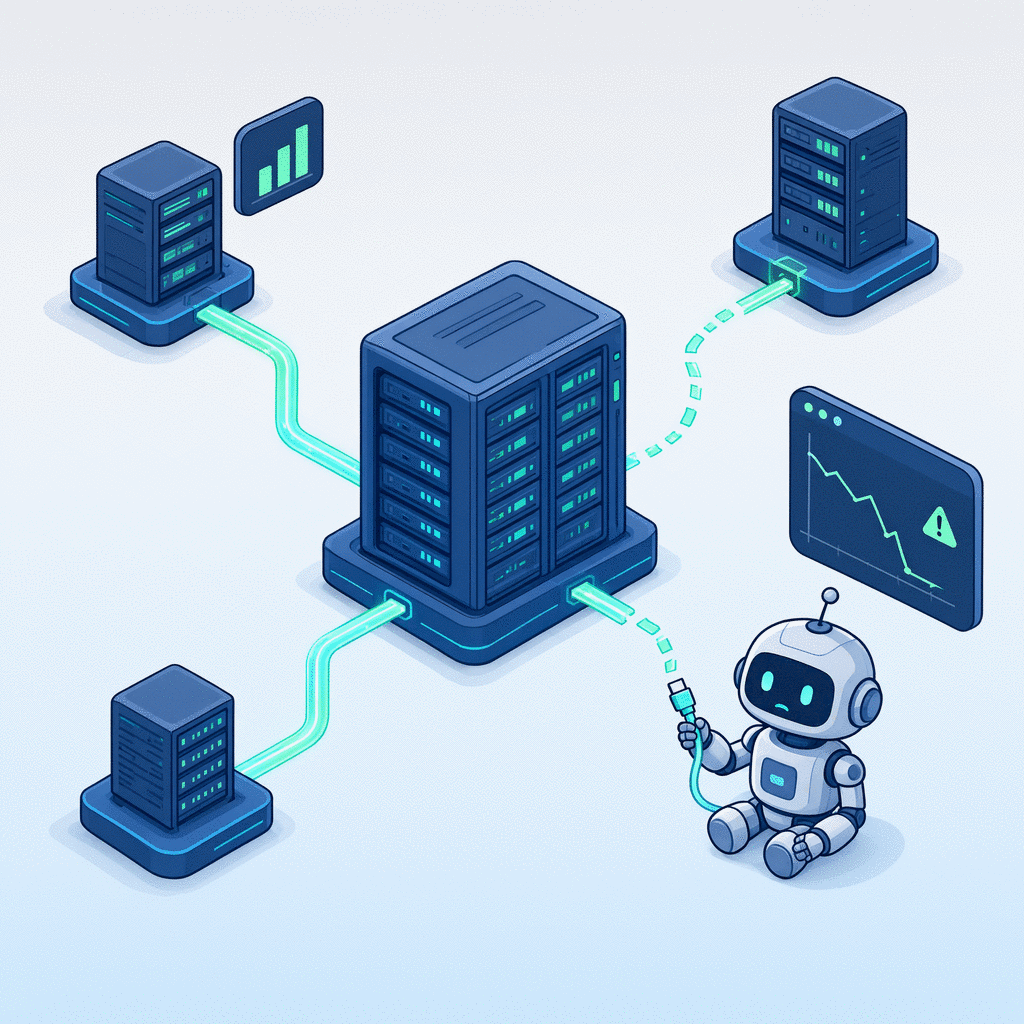
When people talk about unindexed backlinks, the problem has always been framed in one direction: if Google does not index the page linking to you, that backlink passes no authority, does not improve your rankings, does nothing. It is as if it did not exist.
That is still true. But in 2026 there is a second problem that few people are considering.
Generative AI systems, ChatGPT, Perplexity, Gemini, Google AI Overviews, are starting to influence how people discover content. When someone asks Perplexity "what is the best tool for monitoring backlinks?", the answer does not come from a Google ranking. It comes from a model that has read millions of pages and decides which sources to cite.
And here is the point: if your backlink is not indexed in Google, it is probably not in the data these models use to generate responses either. That is not an absolute certainty, because LLMs have their own data collection processes, but the correlation is strong. The pages Google indexes are the same ones that LLM crawlers find and process.
An unindexed backlink is, in practice, invisible to both ecosystems.
How AI decides whom to cite
LLMs do not work like a traditional search engine. Google gives you a list of links ranked by relevance. An LLM generates a response in natural language and, when it can, cites the sources it considers most reliable.
How does it decide which ones are reliable? Semrush published a study on this in 2026, and the factors that carry the most weight are fairly logical:
Consistent mentions. If your brand appears across multiple relevant sources, the model associates you with that topic. It is not so different from what Google does, but the threshold is different. An AI model needs to see repeated patterns to "understand" that your brand is a reference in a specific area.
Topical associations. It is not enough to be mentioned. Where and alongside what matters. If your brand appears in articles about backlink indexing, SEO tools, and link building, the model associates you with that topic cluster. If you appear on a recipe site, the association is weak or nonexistent.
Context of the mention. A mention that says "X is a tool we use to verify indexing" carries more than "X is a technology company." Models extract the surrounding context to understand what you do.
Retrievable sources. This is the point that connects directly to indexing. LLMs need to be able to read the content to process it. If a page is not indexed, if it is not accessible to crawlers, if it is behind a login or blocked in robots.txt, the model cannot access it. And what it cannot read, it cannot cite.
Co-citation: appearing alongside the names that matter
There is a concept gaining weight in SEO that has direct implications for AI: co-citation.
Co-citation happens when your brand is mentioned alongside other recognized brands in your space. If an article talks about "the best indexing tools" and mentions MyBacklinkIndex alongside Ahrefs, Semrush, and Google Search Console, that creates an association. For both Google and LLMs, your brand starts to become part of that reference group.
AI systems use these associations very directly. When someone asks about indexing tools, the model searches its data for which brands appear most frequently in that context. If your brand is in that pool of associations, you are more likely to appear in the response.
And what if the article mentioning you is not indexed? The co-citation does not happen. The model did not process that page. The association did not form. It is as if the mention never existed.
That is why backlink indexing is no longer just a question of authority for Google rankings. It is a question of visibility in a completely new ecosystem.
Retrievability: if they can't read it, it doesn't exist
Semrush uses a term that describes the problem well: retrievability. It is the ability of a system, whether a search engine or an LLM, to find, access, and process your content.
A link on an indexed, accessible page with content in plain text has high retrievability. Google crawlers find it, Perplexity crawlers find it, ChatGPT crawlers find it.
A link on a page that is not indexed, or blocked, or only loads with JavaScript has low retrievability. No system processes it. The link it contains is a ghost.
The formats that work best for AI to process your content and your links are:
- Content in the article body, not in sidebars, footers, or widgets.
- Podcast show notes with transcripts.
- YouTube video descriptions with explicit links.
- Publicly accessible newsletter archives.
- Resource lists with real URLs and descriptive text.
In all these formats, the necessary condition is the same: the page has to be indexed. If it is not, the format does not matter. The content is invisible.
What to do with backlinks that don't get indexed
That covers the diagnosis. What about the practical part?
The first step is verifying which of your backlinks are indexed. You can use Google Search Console for a general overview, but to check specific URLs you need a tool that queries Google's index directly. At MyBacklinkIndex you can submit your backlink URLs and check in seconds which ones are indexed and which are not.
The second step is understanding why a backlink is not indexed. The most common reasons:
- The page linking to you has little original content or is low quality. Google does not consider it worth indexing.
- The page is new and Google has not crawled it yet. This resolves with time, but you can speed it up. Here we explain what to do in that case.
- The page is blocked in robots.txt or has a noindex meta tag. In that case, the link will never be indexed without the owner changing the configuration.
- The site has technical problems: slow loading, server errors, poor structure.
For the first two cases, sending signals to search engines to crawl the page is the solution. At MyBacklinkIndex we work for a full month on each URL, sending continuous signals to crawlers. We do not stop when the URL gets indexed: we keep reinforcing the signal so it stays.
For cases of technical blocking, the solution is different: contacting the site owner and asking them to fix the problem. If it is a link you got through a guest post or Digital PR, it is reasonable to ask them to check the page's indexing configuration.
What makes no sense is leaving backlinks unverified. Every unindexed link is a wasted opportunity, both for Google rankings and for AI visibility.
We give you 2000 free credits to verify your backlinks. No credit card needed. Enough to check 20 URLs.
Summary
An unindexed backlink passes no authority in Google. You already knew that. What you might not have considered is that AI systems cannot see it either.
ChatGPT, Perplexity, Gemini, and Google AI Overviews use accessible, indexed content to decide whom to cite. If your backlink is not in the index, it does not contribute to your AI mentions, does not form part of co-citation associations, and does not improve your retrievability.
Backlink indexing is no longer just a traditional SEO topic. It is the gateway to visibility in the next content discovery ecosystem.
Verify your backlinks. The indexed ones, keep them alive. The ones that are not, send signals so that crawlers visit them.
Adrián
Cofounder of MyBacklinkIndex. Responsible for product and SEO. Before starting this project he worked in the IT department of an American newspaper, where he learned first-hand how search engines treat content.
Related articles
6 link building strategies that work in 2026
Quality over quantity: backlinks worth indexing
2000 free credits to try our service
No credit card needed. Enough to index 20 links. We stand behind our work.
Start Indexing Free