Local link building: backlinks Google values in your area
If your business depends on customers in a city or region, you don't need the same links as a global company. You need links that Google associates with your geographic area. How to get them.
 DavidOct 7, 202610 min read
Why local links are different
If you have a dental clinic in a city, a hardware store, or a restaurant, your audience is not everywhere. It is in your city and perhaps the surrounding towns. Google knows this, and its local search algorithms account for it.
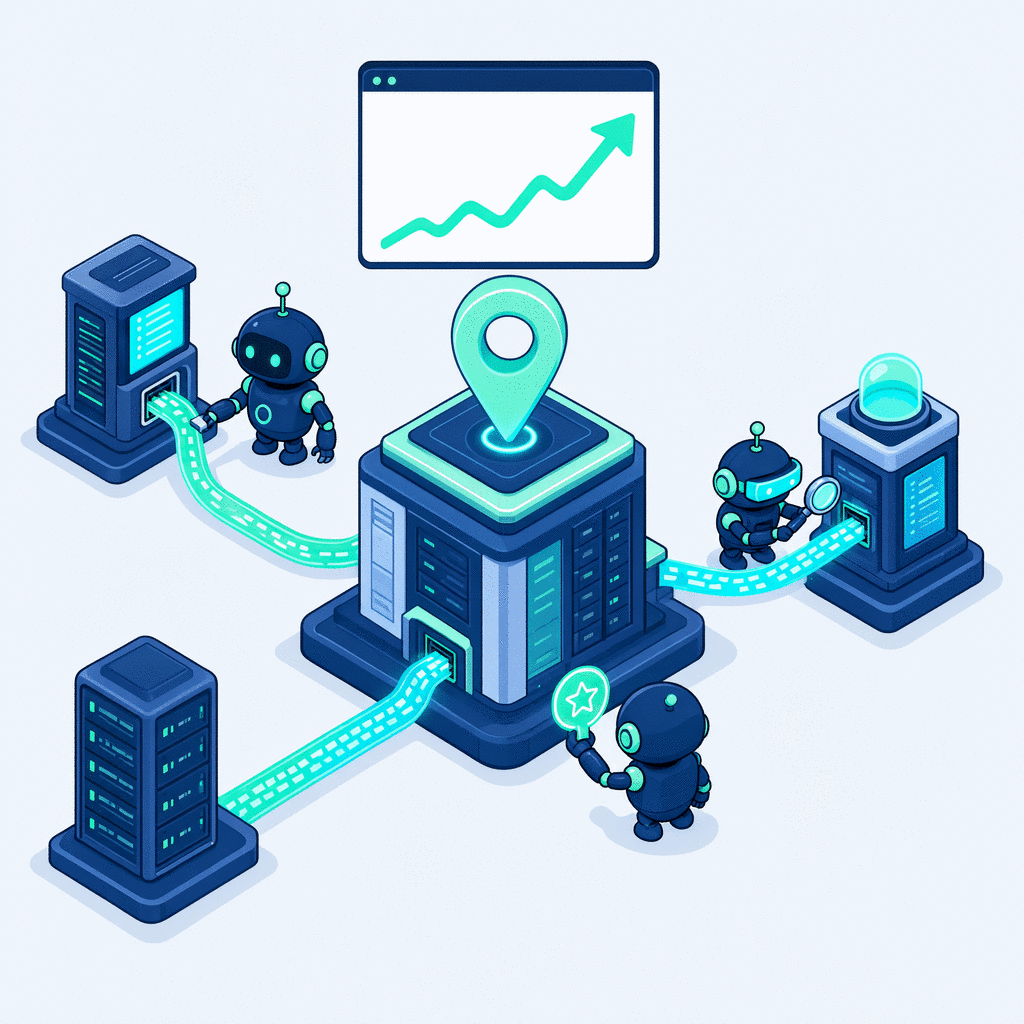
Local links differ from "normal" links in one key aspect: they don't just provide authority, they provide geographic relevance. When a local newspaper links to you, or a neighborhood business association mentions your business, Google interprets that as a signal that your business is relevant to that specific area.
You don't get that from a link on a digital marketing blog with readers worldwide. The link may have more authority in absolute terms, but less local relevance. And for searches like "dentist near me" or "hardware store in [city]," local relevance is what counts.
Local SEO has its own rules, and local link building does too. This article covers the most accessible local link sources and how to use them.
Local directories: which ones are worth it
Not all directories are trash. There is an enormous difference between a generic directory that accepts any website without review and a local directory with real editorial standards.
Directories worth your time have these characteristics:
- They cover a specific geographic area (your city, your province, your region).
- They have a review process before accepting your listing. If it accepts anyone, Google knows.
- They include complete business information: address, phone, hours, description, photos.
- They have real traffic. If nobody visits the directory, the link adds nothing.
Types of local directories that work:
Google Business Profile. By far the most important. It is not a link in the traditional sense, but it is the foundation of your local presence on Google. More on this in the dedicated section.
Industry-specific local directories. If you are a dentist, look for dental directories in your region. If you are a lawyer, lawyer directories in your city. These directories have dual relevance: topical and geographic.
Chambers of commerce and business associations. Local chambers of commerce usually have directories of member businesses. Being in these directories not only gives you a link, it gives you credibility. Google recognizes these institutions and values the links coming from them.
Tourism and local leisure guides. If your business has a tourism or leisure component, local guides for your city are an excellent link source. "Best restaurants in [city]," "What to do in [city] this weekend," "Services guide in [city]."
What is NOT worth it: generic international directories that accept any website, directories with no traffic, and directory networks that copy the same listing across 50 sites with different domains.
Local press and media
A link from a local newspaper or regional magazine is, for local SEO, more valuable than a link from a national general-interest outlet.
Why? Because Google interprets the geographic context of the outlet. If your city's main newspaper mentions you, Google understands that your business is relevant to that area.
How to get local media coverage:
Press release with a local angle. Don't send a generic press release about your company. Find a local angle: opening, collaboration with a neighborhood entity, an interesting data point about your industry in the area, a local charity initiative. Local journalists need content with a direct connection to their coverage area.
Expert commentary. If a news story in your industry affects your area, contact the journalist and offer an expert comment. "In our city, 40% of my clinic's patients ask about this before deciding" is more valuable for a local outlet than a generic opinion.
"Local businesses" or "neighborhood businesses" sections. Many local outlets have dedicated sections for presenting businesses in the area. They are more accessible than general news sections and are usually open to collaborations.
Collaborations with businesses in your area
Businesses that share your geographic area are a link source that almost nobody explores. We are not talking about link exchanges (that goes against Google's guidelines). We are talking about real collaborations that generate natural mentions.
Concrete examples:
Suppliers and clients. If you work with local suppliers, ask if they have a "clients" or "case studies" section on their site. If your dental supply company mentions you as a client on their references page, that is a natural and relevant link.
Complementary businesses. A hair salon and a beauty spa, a plumber and an electrician, a restaurant and a local winery. They don't compete with each other but serve the same audience. Collaborations like joint events, cross-recommendations on blogs, or mentions in "recommended" sections generate organic links.
Local bloggers and influencers. Every city has food, lifestyle, or local tourism bloggers. An invitation to your business in exchange for an honest review generates a link with double geographic relevance: the site is local and the content is about a local business.
The key in all these collaborations is that they be real. Google is getting better at detecting manufactured links. A mention because you genuinely recommended the other business is a link. A mention because you agreed to link to each other is a link scheme.
Local events as a link source
Sponsoring, organizing, or participating in local events is one of the most effective ways to generate links with geographic relevance.
When you sponsor a local event, your logo and link typically appear on the event's website. Event sites are usually well linked by local media, area blogs, and cultural calendars. The link you receive is in a geographically relevant context with authority derived from the event's inbound links.
Types of events that generate links:
- Local trade fairs and markets in your industry.
- Local sporting or cultural events in your city (sponsorship).
- Talks and workshops you give at local venues (coworking spaces, libraries, community centers).
- Open house days at your business.
One nuance: don't sponsor events just for the link. Google values naturalness. If you sponsor a local event because it makes sense for your business and community, the link is a natural consequence. If you do it only for the link, the pattern can look artificial.
Google Business Profile and local SEO
Google Business Profile (formerly Google My Business) is not a backlink in the traditional sense. It does not generate a link that passes authority in the way a newspaper article does. But it is the foundation of all local SEO.
An optimized Google Business Profile makes you appear in Google's "map pack," the three map results that appear when someone searches for a local service. That position can generate more traffic than any backlink.
What you need to have in place:
- Complete listing with real address, phone, hours, correct category, and description with local keywords.
- Updated photos of your business. Google values photo freshness.
- Reviews from real customers. Review quantity and quality are among the most heavily weighted factors in local ranking.
- Regular posts on the listing (Google Posts). Offers, events, news.
- Consistent NAP (Name, Address, Phone) across all sites where you appear. If your address is written differently on every site, Google gets confused.
Google Business Profile does not replace backlinks, but it complements them. A business with good local links AND an optimized Google listing has a significant advantage over the competition in local searches.
Verifying your local links are indexed
After getting several local links, the step you must not skip is verifying that they are indexed.
Local sites tend to have indexing problems more frequently than large outlets. A local business directory may have an old CMS, slow loading, or technical issues that prevent Google from indexing its pages. This is more common than you might think. If the page linking to you is not indexed, the link is worthless.
Submit the URLs of your local links to MyBacklinkIndex to verify their status. If any are not indexed, our system will reinforce the signal for a month.
We give you 2000 free credits to verify your links. No credit card needed.
Summary
If your business depends on local customers, your backlinks should reflect that. Links with geographic relevance tell Google your business matters in your area.
The most accessible sources:
- Local directories with real standards (chambers of commerce, industry directories in your area).
- Local press with press releases that have a regional angle and expert commentary.
- Collaborations with complementary businesses in your area.
- Local events you sponsor or organize.
- Google Business Profile as the foundation of your local presence.
And as always: verify that the links are indexed. A local link that Google doesn't index doesn't help you in search results for your area.
David
Cofounder of MyBacklinkIndex. Over 6 years working in indexing and link building. Started in the IT department of a major US newspaper and worked at an agency before founding this project with Adrián.
Related articles


2000 free credits to try our service
No credit card needed. Enough to index 20 links. We stand behind our work.
Start Indexing Free