Real Results: How Agencies Use Our Platform to Index Their Clients' URLs
We're sharing real indexing data from agencies using MyBacklinkIndex. No client names, no backlinks — just the numbers that show how sustained crawl signals translate into progressive indexation across Bing and Google.
 DavidAug 12, 20268 min read

We work with agencies that manage SEO for multiple clients. These agencies submit their clients' own URLs — not backlinks — to our platform, with the goal of improving indexation in search engines.
Below we're sharing real data from a set of client campaigns managed by agencies using MyBacklinkIndex. We're not naming the clients or showing their websites — that's private. But we are showing the screenshots from Webmaster Tools and Search Console, because the numbers tell the story.
How it works
The concept is straightforward. Agencies send us URLs from their clients' sites. Our platform then sends sustained crawl signals to search engine bots over the course of a full month, inviting them to discover and recrawl those URLs.
This isn't a one-shot ping. It's a continuous process that creates a pattern of signals over time. The bots visit, evaluate, and — when the content and site quality are right — index. That said, we can't control the search engine's final decision. What we do control is ensuring the URLs get crawled consistently.
Bing: 48k indexed, 12.9k with warnings
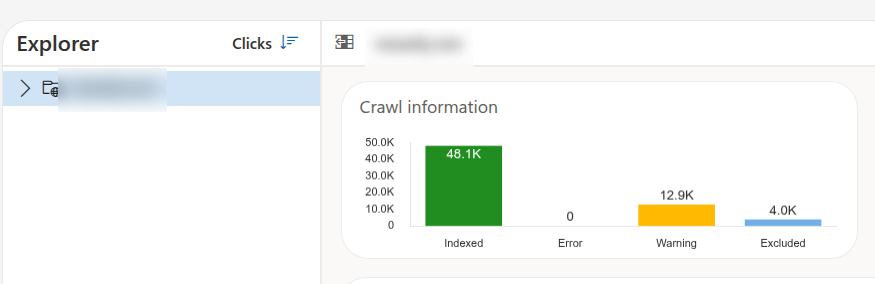
The Bing data shows what happens when a large site with thousands of URLs goes through sustained crawl signal work:
- 48.1k URLs indexed — these are fully indexed and appearing in Bing's search results.
- 4.0k URLs pending — crawled but not yet added to the index. These are still in the evaluation queue.
- 12.9k URLs indexed with warnings — these are technically indexed, but Bing flagged issues like duplicate titles, titles that are too short or too long, or other on-page problems. The key point: they are still indexed. The warnings don't prevent indexation, but they do signal areas where the client can improve their content to perform better.
The 12.9k with warnings are not a failure. They're indexed. But they represent an opportunity: fix the titles, improve the meta descriptions, clean up duplication, and those pages move from "indexed with issues" to fully optimized. That's work that depends on the site owner, not on us. Our job was to get them crawled and indexed in the first place.
Google crawl activity: 172k requests since May
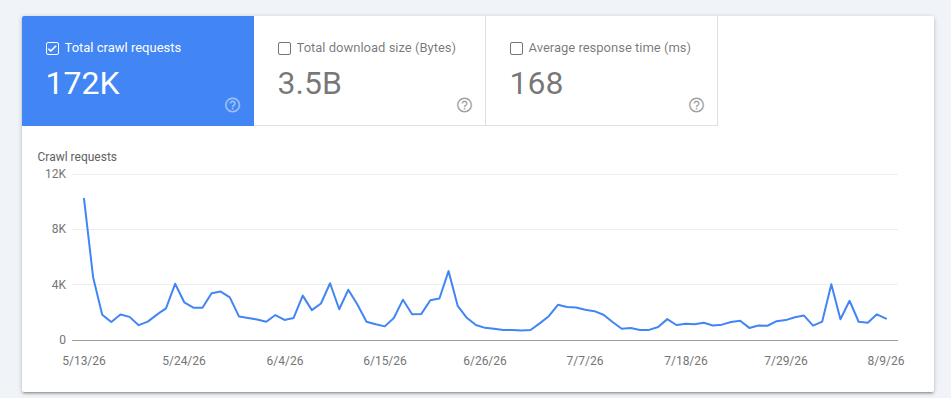
This is the Google crawl data from another client site. The story here is the pattern, not just the total number:
- 172k total crawl requests from Google since the campaign started in May.
- Peaks of 11k crawls per day — Google picking up large batches of URLs when it detects new signals.
- Average of ~3,000 URLs crawled per day — a consistent baseline that shows Googlebot is regularly returning to the site.
The fluctuations are normal. Google doesn't crawl at a fixed rate. It responds to signals: new content, updated pages, and external prompts like the ones our platform sends. What matters is the sustained baseline. Google keeps coming back. That's the signal that eventually leads to indexation.
Without ongoing crawl signals, many of these URLs would see Googlebot visit once and never return. The repeated visits are what create the opportunity for indexation.
Progressive Google indexation: from 0 to 3.8k
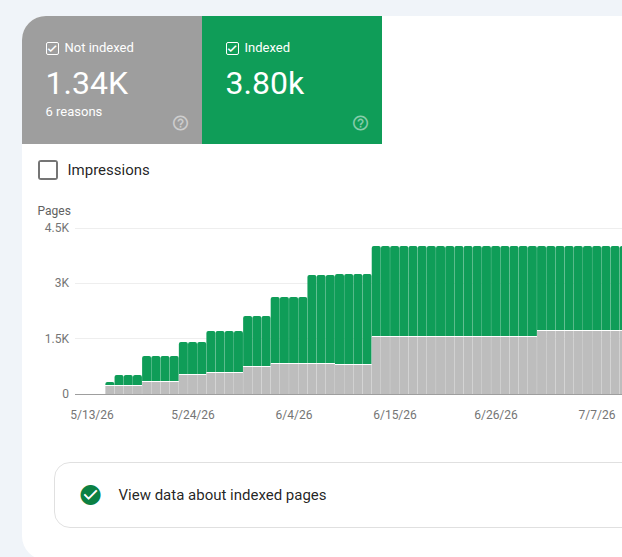
This is the most telling chart. It shows a large cosmetics e-commerce site that started with zero indexed URLs in May and has grown to 3,800 indexed pages by August.
This didn't happen overnight. It happened progressively, month by month, as our platform sent sustained crawl signals and Google discovered, evaluated, and indexed the URLs in batches.
What you see in the chart is the real behavior of Google's indexing system:
- It doesn't index everything at once. It evaluates sites in waves.
- New batches of URLs get indexed as Google gains confidence in the site's quality and the signals it receives.
- The growth is consistent, not explosive — which is exactly what a healthy indexing pattern looks like.
For a cosmetics site with thousands of product pages, this kind of progressive indexing is normal and expected. The important thing is that the curve is going up, and that the growth is sustained. That's a sign that the crawl strategy is working.
Key takeaways
Looking across all three data sets, a few things stand out:
1. Bing is faster, Google is more demanding. Bing tends to respond quicker and with fewer conditions. Getting a URL indexed in Bing is comparatively easier. Google takes more time, evaluates more signals, and is stricter about content quality. Both are worth targeting.
2. Consistency beats intensity. The agencies that get the best results are the ones that submit URLs and let the platform work over the full month. One-off pings don't create the sustained pattern that search engines respond to.
3. Crawling is the prerequisite, not the guarantee. Getting crawled is the first step. Indexation depends on content quality, site structure, and dozens of other factors. Our platform guarantees the crawling. The rest depends on the site owner.
4. Indexed-with-warnings is still indexed. The Bing data showed 12.9k URLs indexed with warnings. Those pages are live in search results. The warnings are an optimization opportunity, not a blocker. Fix the titles, clean up duplicates, and those pages perform even better.
5. Progress is visible within weeks. You don't need to wait six months to see if it's working. The crawl stats and indexation charts show movement within the first few weeks. The trend is what matters, not any single day's numbers.
Try it yourself
If you manage client sites — or your own — and you're seeing pages stuck in "Discovered" or "Crawled - currently not indexed," sustained crawl signals can make the difference.
We give you 2,000 free credits when you sign up. Enough to start indexing 20 URLs and see the pattern in your own Search Console. No credit card required.
David
Co-founder of MyBacklinkIndex. 6+ years in indexing and link building. Started in the IT department of a major US newspaper, worked at an agency, then built this project with Adrián.
Related articles

2000 free credits to try our service
No credit card. Enough to index 20 links. We trust our work.
Start Indexing Free